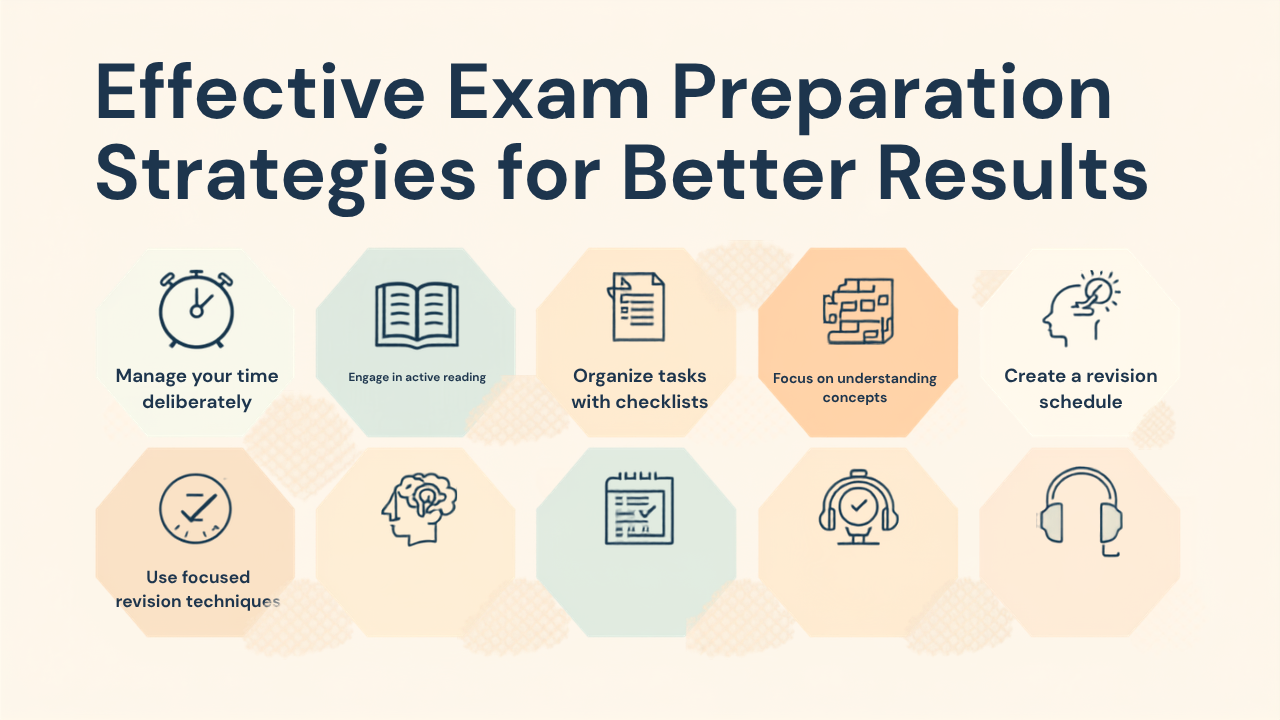
Exams are an important part of every student’s academic journey, but preparing for them does not have to be stressful. Many students believe that spending long hours with books automatically leads to better scores. In reality, successful exam preparation depends more on studying smart than studying endlessly. A clear plan, consistent practice, and healthy routines often produce better results than last-minute cramming.
Imagine two students preparing for the same examination. One starts studying a few weeks in advance, follows a schedule, takes regular breaks, and revises consistently. The other waits until the final days, studies late into the night, and skips revision. Even if both are equally intelligent, the first student is more likely to perform confidently because preparation was organized and balanced.
Research in educational psychology consistently shows that spaced learning, active recall, and regular revision improve memory retention more effectively than repetitive reading. These evidence-based techniques have become widely recommended by educators and learning experts worldwide.
This guide explains practical and effective exam preparation strategies that can help students improve focus, manage their time wisely, and achieve better academic results.
Why a Well-Planned Study Strategy Matters
Many students spend hours reading textbooks without realizing that effective learning requires planning. A structured study strategy helps reduce confusion, keeps progress measurable, and ensures that every subject receives enough attention.
Instead of randomly choosing topics each day, divide the syllabus into smaller sections. This makes large subjects feel more manageable and reduces the chances of overlooking important chapters.
Planning also provides psychological benefits. Completing small daily goals creates a sense of achievement that keeps motivation high throughout the preparation period.
Some key advantages of a structured study plan include:
- Better time management
- Reduced exam stress
- Improved confidence
- Consistent revision
- Balanced preparation across subjects
Students who organize their study sessions are often better prepared because they spend less time deciding what to study and more time actually learning.
Set Realistic Daily and Weekly Goals
One of the most effective ways to prepare for exams is to create achievable study goals. Instead of writing “Study Science,” break it into smaller objectives such as:
- Complete one chapter
- Solve twenty practice questions
- Revise class notes
- Review formulas
Small goals make studying less intimidating and help track progress more accurately.
For example, if a student has six subjects and thirty days before exams, dividing each subject into manageable sections allows enough time for revision without feeling overwhelmed.
Understand the Exam Pattern
Before beginning preparation, understand how the examination is conducted.
Ask yourself:
- How many marks is each section worth?
- Which chapters carry more weight?
- Are there multiple-choice questions?
- Will descriptive answers be required?
- Is negative marking involved?
Knowing the exam pattern helps prioritize important topics while maintaining balanced preparation.
Many students lose marks not because they lack knowledge but because they misunderstand question formats or time allocation.
Create a Practical Study Schedule
An effective timetable should match your personal learning style and daily routine.
Include:
- Study sessions
- Revision periods
- Practice tests
- Short breaks
- Sleep
- Physical activity
Avoid scheduling unrealistic study hours. A timetable should be sustainable for several weeks rather than only a few days.
Consistency is far more valuable than occasional marathon study sessions.
Proven Study Techniques That Improve Learning
Effective learning is based on understanding concepts rather than memorizing information. Modern educational research supports several techniques that improve both comprehension and long-term memory.
Use Active Recall Instead of Passive Reading
Active recall is one of the most powerful learning methods.
Rather than repeatedly reading notes, close the book and try to explain the topic from memory.
Ask yourself questions like:
- What are the main concepts?
- Can I explain this chapter without looking?
- What examples support this topic?
This process strengthens memory pathways and helps identify weak areas.
Students often discover that they understand less than they initially believed, allowing them to focus on improving those sections.
Practice Spaced Repetition
Instead of revising everything in one day, review the same topic multiple times over several days or weeks.
For example:
- Learn today
- Revise after two days
- Review again after one week
- Final revision before the exam
Spaced repetition improves long-term retention because the brain strengthens memories through repeated exposure over time.
Solve Practice Questions Regularly
Reading alone is not enough.
Practice helps students:
- Improve speed
- Understand question patterns
- Build confidence
- Identify common mistakes
If previous years’ question papers are available, solve them under timed conditions.
This creates familiarity with exam pressure and improves time management during the actual examination.
Teach Someone Else
One surprisingly effective learning method is teaching.
Explain difficult topics to a friend, sibling, or even yourself.
When you teach, your brain organizes information logically, making it easier to remember later.
If explaining feels difficult, it usually means additional revision is needed.
Make Smart Notes
Avoid copying entire textbook pages.
Instead, create concise notes using:
- Keywords
- Flowcharts
- Mind maps
- Tables
- Diagrams
- Color coding
These summaries become valuable during final revision when time is limited.
Focus on Understanding Instead of Memorizing
Many students memorize answers word for word without understanding the underlying concepts.
However, exams increasingly test application rather than memorization.
For example, understanding why a scientific process occurs is more useful than simply remembering its definition.
Conceptual learning allows students to answer unfamiliar questions with greater confidence.
Time Management During Exam Preparation
Time management is often the biggest challenge for students.
Successful preparation requires balancing multiple subjects while avoiding burnout.
Some practical approaches include:
Prioritize Difficult Subjects
Study challenging subjects when your concentration is highest.
Many students prefer mornings because the mind feels fresh after adequate sleep.
Easier topics can be studied later in the day.
Follow the Pomodoro Technique
One popular productivity method involves:
- Study for 25 minutes
- Take a 5-minute break
- Repeat four cycles
- Take a longer break
Short breaks help maintain concentration and reduce mental fatigue.
Avoid Multitasking
Studying while checking social media, watching videos, or replying to messages reduces focus significantly.
Research suggests that task switching lowers productivity because the brain requires time to refocus after every interruption.
Keeping distractions away during study sessions improves efficiency.
Leave Time for Revision
Revision should never be postponed until the final day.
Ideally:
- First learning
- Weekly revision
- Monthly revision
- Final revision before exams
This layered approach strengthens memory and improves recall during examinations.
Healthy Habits That Support Better Learning
Academic success depends not only on studying but also on maintaining physical and mental well-being.
Get Enough Sleep
Sleep plays a critical role in memory consolidation.
Students who regularly sleep seven to nine hours often remember information better than those who sacrifice sleep for extra study time.
Late-night cramming may create the illusion of productivity while actually reducing concentration the following day.
Eat Balanced Meals
The brain requires steady nutrition to function effectively.
Include foods rich in:
- Whole grains
- Fruits
- Vegetables
- Nuts
- Seeds
- Protein sources
- Plenty of water
Balanced nutrition supports concentration throughout long study sessions.
Stay Physically Active
Even twenty to thirty minutes of walking, stretching, or light exercise can improve mood, reduce stress, and increase focus.
Physical activity improves blood circulation to the brain, supporting cognitive performance.
Manage Stress Positively
Feeling nervous before exams is normal.
Helpful stress-management techniques include:
- Deep breathing
- Meditation
- Short walks
- Listening to relaxing music
- Talking with supportive family or friends
Maintaining emotional balance helps improve concentration and decision-making during exams.
Common Mistakes Students Should Avoid
Many students unknowingly reduce their performance through ineffective habits.
Common mistakes include:
Starting Too Late
Delaying preparation creates unnecessary pressure and limits revision opportunities.
Beginning early allows gradual learning and reduces anxiety.
Ignoring Weak Topics
Some students repeatedly revise subjects they already know while avoiding difficult chapters.
Improvement comes from strengthening weaker areas.
Memorizing Without Practice
Understanding concepts is important, but applying them through practice questions is equally essential.
Practice reveals knowledge gaps that reading alone cannot identify.
Comparing Yourself with Others
Every student learns differently.
Comparing study hours or progress with classmates often increases stress instead of motivation.
Focus on personal improvement rather than competition.
Studying Without Breaks
Continuous studying for several hours decreases concentration.
Short breaks refresh the mind and improve learning efficiency.
Preparing Effectively on the Day Before the Exam
The final day should focus on reinforcing knowledge rather than learning entirely new topics.
A productive routine may include:
- Reviewing summary notes
- Revising formulas and key concepts
- Solving a few practice questions
- Organizing exam materials
- Sleeping on time
Avoid trying to cover the entire syllabus in one day.
Confidence comes from consistent preparation rather than last-minute panic.
Exam Day Strategies for Better Performance
Preparation continues even after entering the examination hall.
A few simple habits can improve performance:
Read every question carefully before answering.
Start with questions you know well to build confidence.
Manage time wisely so every section receives adequate attention.
Review answers if extra time remains.
Stay calm even if one difficult question appears. Most examinations contain questions with varying difficulty levels.
Maintaining composure allows clearer thinking and better decision-making.
Building Long-Term Study Habits
Effective exam preparation is not only about achieving good marks in one examination. It is about developing lifelong learning habits.
Students who consistently review lessons, ask questions, stay organized, and practice regularly often experience continuous academic improvement over time.
Building these habits also prepares learners for higher education, professional certifications, and workplace learning where independent study becomes increasingly important.
Every successful learner develops a routine that balances discipline with flexibility. Small improvements made each day eventually lead to significant academic growth.
Effective exam preparation is a combination of planning, consistent effort, evidence-based study techniques, and healthy daily habits. Rather than relying on last-minute revision, students benefit most from creating realistic schedules, understanding concepts deeply, practicing regularly, and revising over time. Active recall, spaced repetition, practice tests, and proper time management are proven strategies that improve both confidence and performance. Alongside academic preparation, adequate sleep, balanced nutrition, physical activity, and stress management support better concentration and memory. By following these practical approaches consistently, students can prepare more efficiently, reduce exam anxiety, and achieve better results while developing study habits that continue to benefit them throughout their educational journey.
